

Most investors think of coal as an industry in slow retreat. The data say otherwise. The world burned more coal in 2024 than in any year before it, about 165 exajoules, and the IEA estimates that 2025 set another record, at roughly 8.84 billion tonnes. Coal still generated 33% of the world’s electricity last year. Renewables passed it for the first time, by less than a percentage point.
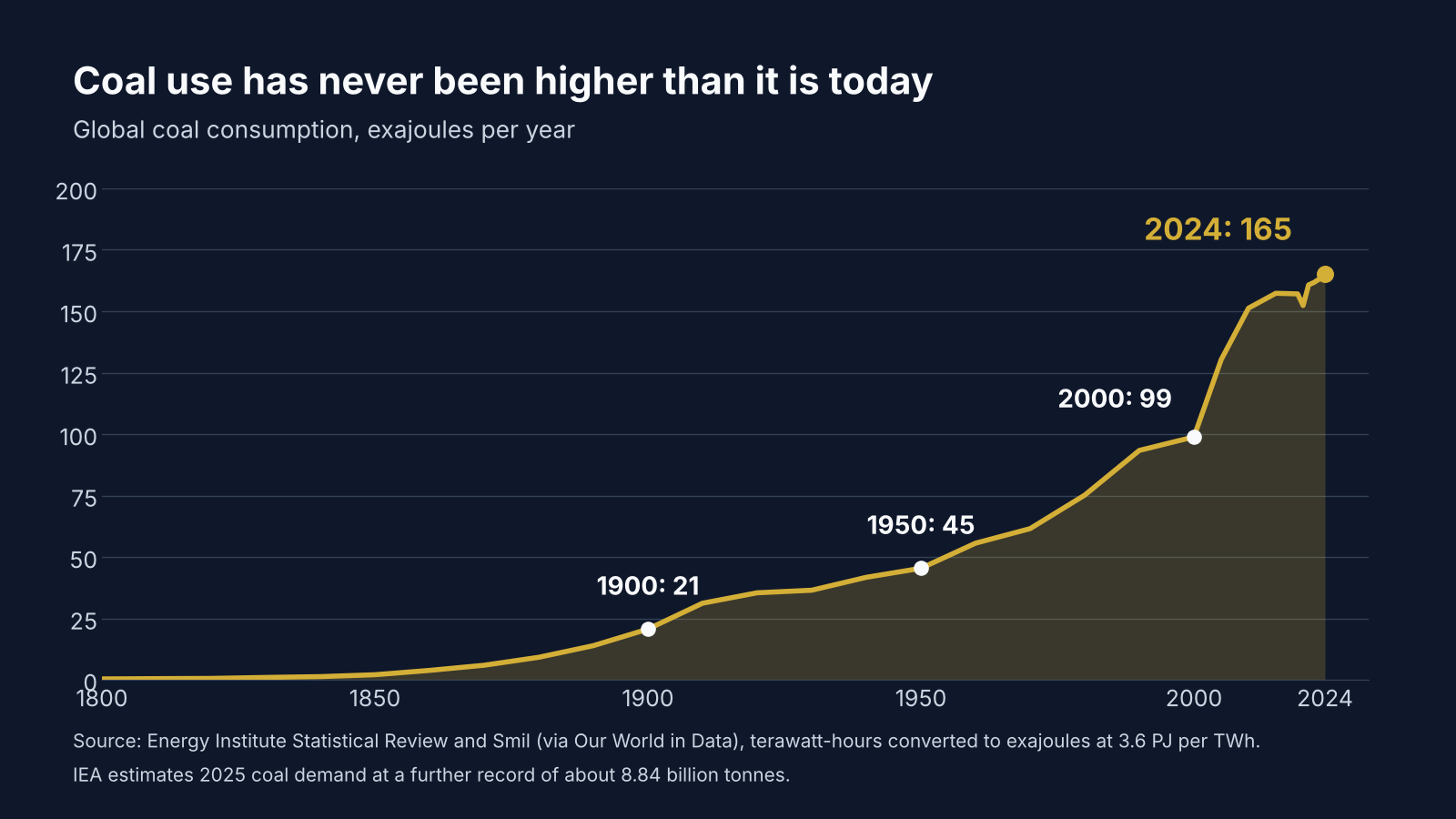
The chart shows why the retreat story is hard to square with the numbers. Coal use has grown in almost every decade since 1800, and it is about two thirds higher today than in 2000. The IEA expects a plateau and then a gradual decline, with demand about 3% below the 2025 level by 2030.
This report is about one part of that market: thermal coal that is shipped by sea, which is the coal that Japan, South Korea, Taiwan and much of South and Southeast Asia buy when their own mines and gas supplies are not enough. Its price, set at Newcastle in Australia, is the one that decides what the producers in this report earn.
Why now
Twice in four years, the supply of liquefied natural gas has failed the buyers that rely on it. The first time was after Russia invaded Ukraine in 2022. The second is this year, with the war around Iran and the closure of the Strait of Hormuz, which has taken a large part of Qatar’s LNG out of the market. Newcastle coal trades near $150/t as we write, up sharply on the year, and every forecast we have found expects it to fall.
We think the market is treating a structural change as a temporary one. Buyers that built their power systems on the assumption that gas would always be available have now seen it disappear twice. Plants that were due to close are running harder, and new LNG terminals are expensive and slow to build. At the same time the supply of coal is spread across several exporters, and each of them has run into a limit this year on how much more it can ship. These points do not make coal a growth industry, and we say where the thesis can fail in the final chapter, but they do mean that the long-run price may be higher than the forecasts assume.
What this report covers
We look at the case from the demand side, the supply side and the price, and then at the companies that turn it into cash. Thungela, New Hope (with its Malabar and Maxwell assets) and Yancoal get full sections and valuations. Whitehaven and Glencore are covered more briefly, because the first is too mixed to be a clean exposure and the second is a diversified miner and trader in which coal is only one part. For each company we show what the shares are worth at three Newcastle prices, so that readers can compare our assumptions with their own.
The chapters that follow set out the two gas shocks, who still needs imported coal, who can supply it, what sets the Newcastle price, the five companies, their valuations and the risks.