

The FNX Playbook, Revisited
There is a specific type of mining opportunity that rarely announces itself loudly. It does not come with a freshly drilled discovery hole splashed across the wires, or a management team making their debut on the conference circuit. It comes, instead, from people who have already done something once, people who understand a specific piece of ground at a level that no outsider can replicate, and who are quietly doing it again.
Magna Mining (TSXV: NICU) is that kind of opportunity.
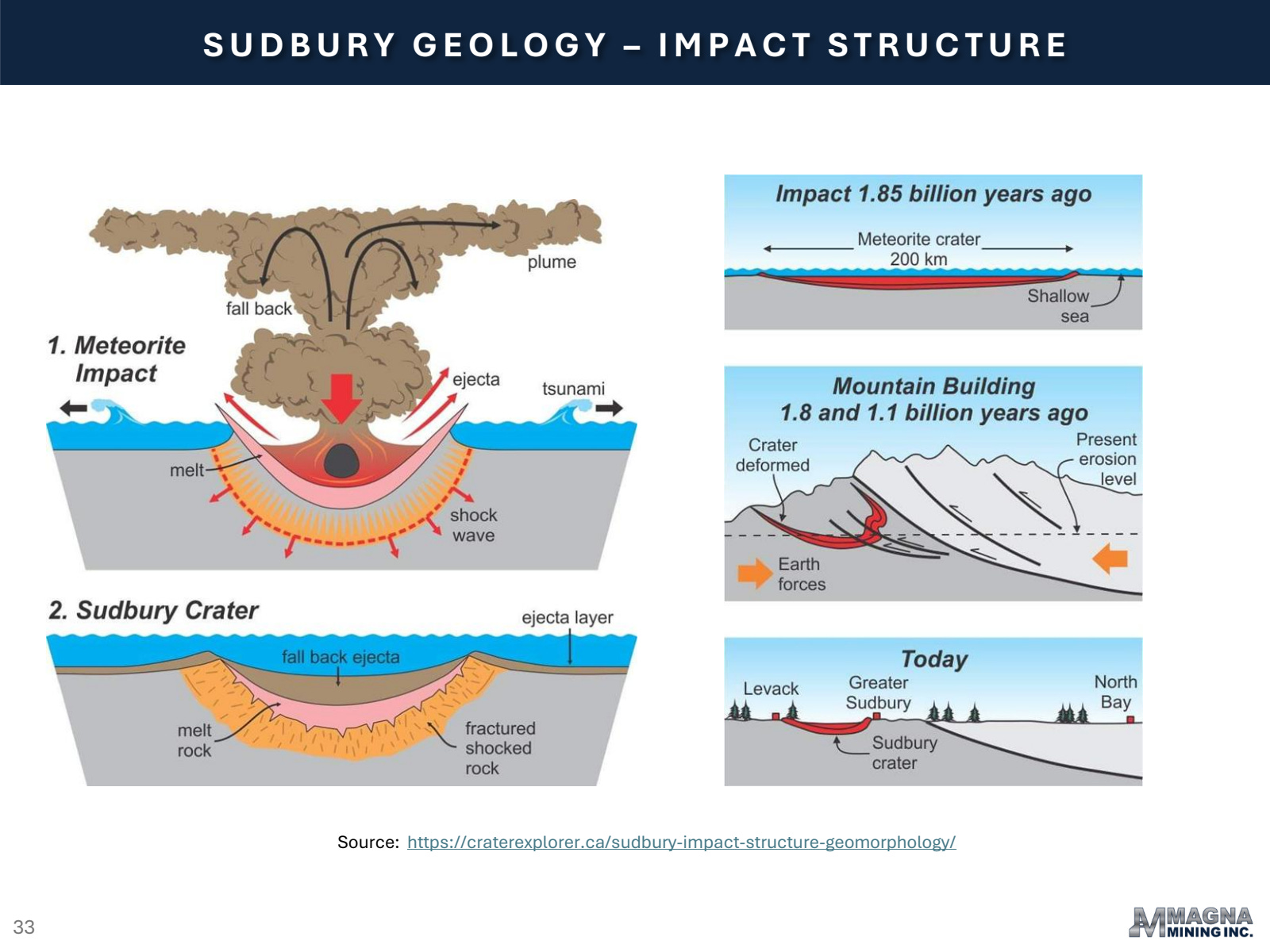
The Sudbury Basin in Northern Ontario is one of the most extraordinary mineral endowments on earth. Formed roughly 1.85 billion years ago by a meteorite impact that fractured and remixed the underlying geology, the Basin hosts a concentration of nickel, copper, cobalt, platinum, palladium and gold that has sustained continuous industrial-scale mining for over 130 years. Vale and Glencore have built their global base metals franchises, in part, on what lies beneath this one crater. Yet what makes Magna interesting is not Sudbury’s past. It is who is running Magna, what they already know about the ground they are sitting on, and how much of it the market has not yet priced in.
To understand why, you need to understand what FNX Mining was, what it did, and what happened to it.
FNX was a small Canadian junior that, in the early 2000s, acquired a package of undervalued, non-core Sudbury assets. At the time, the assets were considered largely depleted legacy properties, too small and too complex for a major to bother with. FNX thought differently. Between 2003 and 2010, FNX’s exploration team systematically drilled the footwall systems beneath those properties and discovered a series of high-grade copper-PGM deposits that the majors had walked past for decades.
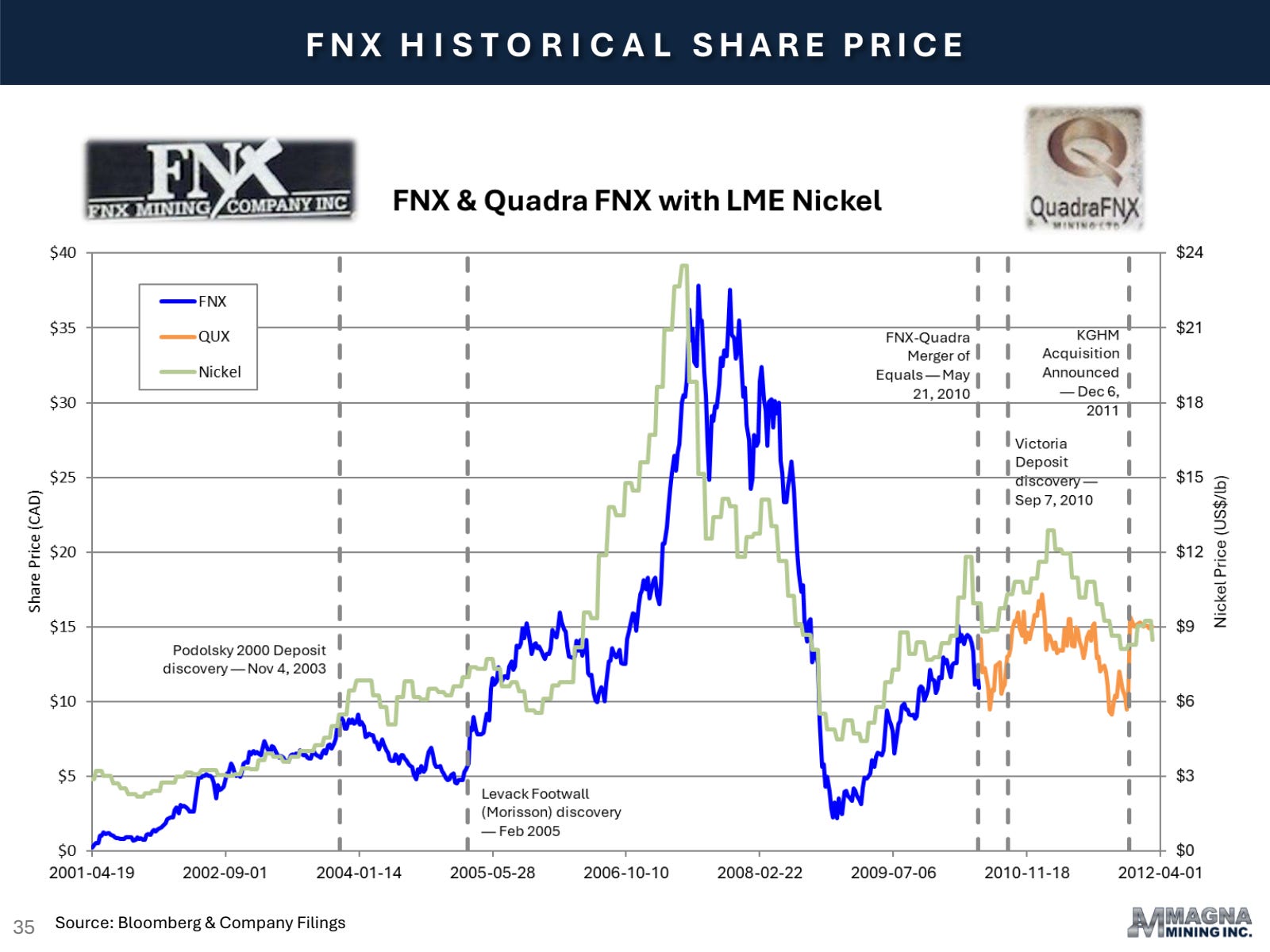
The market noticed. FNX's share price rose from roughly $1 in 2001 to nearly $38 CAD at its peak in early 2008, a return of close to 3,700% over seven years. The correlation with LME nickel was real, and the 2008-2009 commodity collapse hit FNX accordingly, but the recoveries were fast precisely because the underlying asset quality was not in doubt. FNX subsequently merged with Quadra Mining in May 2010 to form Quadra FNX, and the combined entity was acquired by KGHM in early 2012 for approximately $2.9 billion. KGHM then spent the following decade attempting to apply a bulk tonnage production model to assets that were built for selective, high-grade footwall mining, progressively wound down activity across the portfolio, and ultimately placed each mine on care and maintenance until Magna acquired them for a fraction of what KGHM had paid.
Magna is the second chapter. Jessup and several members of the original FNX team have reacquired the same assets, at a fraction of what KGHM paid, at a point when the infrastructure is intact, the permits are in place, and the exploration database accumulated over two decades of FNX and KGHM drilling sits inside Magna’s own systems. The question the market is implicitly asking is whether this team can replicate, in whole or in part, what FNX did between 2003 and 2013. The honest answer is that the conditions for doing so are better now than they were then: copper prices are higher, the geopolitical premium on stable-jurisdiction supply is real, and the team has twenty additional years of knowledge about the Basin that FNX’s founders did not have when they started.
The Team That Has Been Here Before
Magna’s management team is not new to the Sudbury Basin. Several of them built it once already, under a different name.
Jason Jessup (CEO) spent years at FNX Mining during the critical exploration and discovery period before those assets were acquired by KGHM International in 2013. After FNX he moved through Sandstorm Gold and Premier Royalty before returning to the Basin with a specific thesis: that KGHM, a Polish state-owned miner optimised for bulk copper operations, was structurally the wrong operator for these high-grade, selective Sudbury deposits. He has never sold a share of Magna. In an interview in May 2026 he stated directly: “I don’t plan on selling any shares until we’re over a billion-dollar company.” With approximately 10 million shares. The options are not a windfall. They are a forward bet on the same thesis he is asking investors to make.
Jeff Huffman (COO) most recently served as President and COO of Dumas Contracting, one of Canada’s most respected underground mine contractors, responsible for building and operating complex underground mines across the country. He is not a corporate mining executive who visits sites quarterly. He is an underground mine builder, and the photographs in Magna’s own investor presentation show him working in footwall stopes at McCreedy West and the Morrison Deposit as far back as 2010 and 2011, before Magna existed. He knows these exact stopes.
David King (SVP Exploration & Geoscience) served as Senior Manager of Geoscience and Mineral Resources at KGHM International, the prior owner of Levack, McCreedy West and the other assets Magna now controls. Before that, he held the equivalent role at FNX Mining. He is, in a literal sense, the person who built the geological models that sit inside Magna’s exploration database today. When Magna drills a target, King is interpreting the results against a dataset he largely assembled himself.
Shastri Ramnath (Director) spent the early part of his career at Falconbridge and then FNX Mining, where he was a core member of the exploration and resource team during the period when the Basin’s footwall deposits were being discovered and delineated. He is now CEO of Exiro Minerals and Chair of Orix Geoscience, the independent geological firm that completed Magna’s 2025 Levack and McCreedy West resource estimates. His presence on the board is not ceremonial.
Vern Baker (Chairman) was VP Operations at FNX Mining during the same discovery and development era, and subsequently CEO of Jaguar Mining. He chairs a board that includes Jonathan Goodman, President and CEO of Dundee Corporation, which holds around 19% of Magna’s shares outstanding and has a long institutional history of backing Sudbury mining cycles from the early stages.
Gord Morrison (Strategic Advisor) worked 32 years at INCO before becoming SVP Exploration at FNX Mining and subsequently Chief Technology Officer at KGHM International. He is described by peers as one of the foremost experts on Sudbury Basin geology alive. His presence as an advisor gives Magna access to institutional knowledge of the Basin that cannot be hired from a university or a geological survey.
This is not a management team that acquired a set of assets and is now learning the geology. They discovered much of it, they mined it, they understand exactly why the prior owner underperformed, and they know what it would take to unlock it. FNX had an extraordinary performance on the back of exactly the kind of systematic footwall exploration that Magna is now resuming. The R2 Zone at Levack, the 1250 West extension at McCreedy West, and the Keel Zone targets are not speculative greenfield plays. They are the next logical steps in a geological programme that this team started twenty years ago and was interrupted, not concluded, when KGHM took over.
The Sudbury Advantage
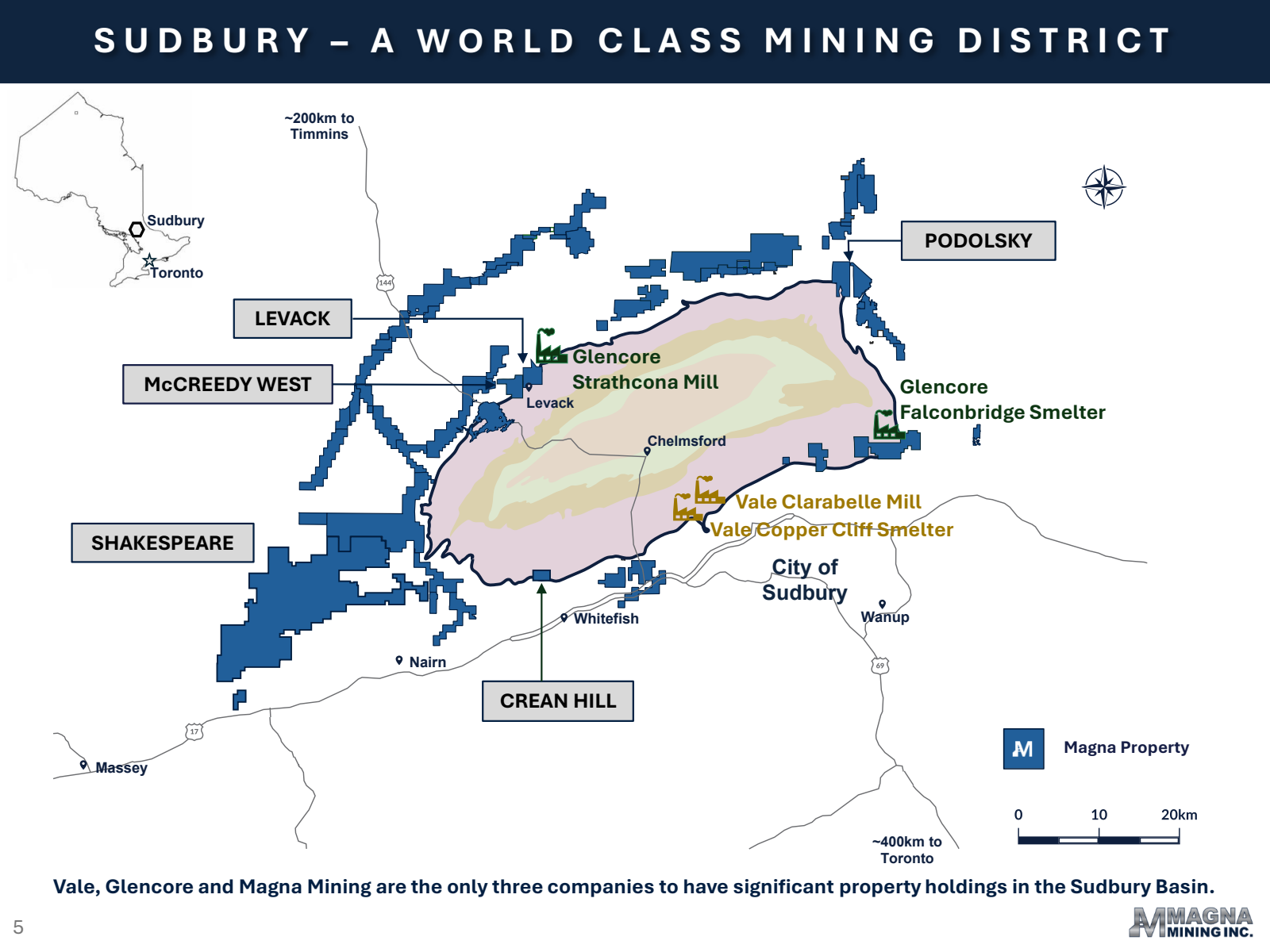
Magna’s assets sit in one of three significant property clusters in the Sudbury Basin. Vale and Glencore hold the other two. This is not a coincidence. The Basin’s geology, combined with over a century of infrastructure buildout, has consolidated ownership into a small number of operators who can actually access and process the ore
The Mill Infrastructure
The critical infrastructure advantage is this: Magna does not need to build a mill. Vale’s Clarabelle facility and Glencore’s Strathcona mill(both included on the map above) together have more processing capacity than current mine supply in the region can fill. Vale has a roughly 3 million tonne per annum shortfall against its mill capacity target. Glencore runs Strathcona at approximately 1.7 Mtpa against a 2.7 Mtpa design capacity. Both companies are actively competing for ore feed, and Magna already has definitive toll milling arrangements in place with Vale, and favourable indications from Glencore based on the bulk sample results from McCreedy West.
The commercial terms are unusual in the best possible way: payment is based on the grade of ore delivered, not the actual recovery achieved in the mill. That means Magna captures the full value of its high-grade footwall material without taking recovery risk in the processing step. For a company mining copper grades of 14 to 30% in individual intercepts at McCreedy and Levack, this structure is highly favourable.
This structural position, sitting between two captive, undersupplied mills in a jurisdiction where the permitting clock has already run, is something that cannot be replicated by a company trying to enter Sudbury from scratch. It took decades of prior operation to build and is one of the main reasons KGHM’s assets were attractive enough for Jessup to bet his career on acquiring them.
The Political Landscape
Mining is, at its core, a political business. The right ore body in the wrong jurisdiction is worth nothing. Sudbury sits in perhaps the most mining-friendly political environment in the developed world, and that environment is getting better, not worse.
Ontario launched a comprehensive update to its Critical Minerals Strategy in early 2026 under the banner “Fortifying Ontario’s Economy: A Plan to Accelerate Responsible Resource Development.” The centrepiece is a new One Project, One Process permitting model with binding service standards designed to cut government review times by up to 50 percent. The province has committed over $500 million to a new Critical Minerals Processing Fund, $25 million to a Critical Minerals Innovation Fund, and has invested $29.8 million through the Junior Exploration Program to support new discoveries. Copper, nickel, cobalt and platinum group metals, all of which Magna produces or expects to produce, sit at the top of both Ontario’s and the federal government’s official critical minerals lists.
The federal picture mirrors Ontario’s direction. Canada’s Critical Minerals Strategy identifies nickel, cobalt and copper as three of the country’s priority minerals for securing supply chains with allied nations. In the context of a broader geopolitical shift toward friend-shoring of strategic materials, Sudbury represents exactly the kind of stable, transparent, rule-of-law jurisdiction that allied industrial nations are willing to pay a premium to source from.
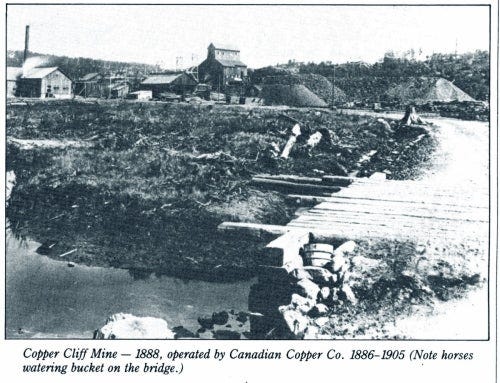
Equally important, and often underestimated by investors unfamiliar with northern Ontario, is the depth of Sudbury’s social licence. The city was founded on mining, and the Sudbury Basin has been continuously mined since 1886. Local, provincial and federal government support for mining is not a talking point in Sudbury; it is the economic foundation of the community. Magna’s existing permits did not come from a blank sheet of paper. They are the product of relationships, regulatory history and community trust that were built over decades by KGHM, FNX and, before them, INCO and Falconbridge.
Contrast this with what a greenfield mining developer faces elsewhere in Canada. A new project in a pristine jurisdiction typically requires many years of environmental assessment, permitting, consultation and social negotiation before the first tonne of ore is moved. Magna’s entire portfolio is already permitted for production. That is not a small advantage. It is a structural moat that cannot be bought or accelerated.
The following sections will cover:
The five assets: what the NI 43-101 numbers actually say, and what the market is missing
The R2 Zone: stream-free, outside the resource model, and won’t appear in the PEA. The economics you’ll see in Q3 are a floor
The Keel Zone: why prior operators avoided it, and why that was a mistake
Crean Hill’s open pit resource that almost no coverage mentions
The asset that has a completed feasibility study and a ramp that stopped 150 metres short of a high-grade deposit
Part 2 "The Numbers & The Thesis" will also be released separately shortly and covers the Franco-Nevada stream, the full NAV model, the catalyst map and the kill list.