

This is Part 2 of my full analysis of Magna Mining ($NICU). If you haven’t read Part 1, I’d recommend starting there; it covers the company background, the FNX origin story and why management’s familiarity with this exact ground matters, the full asset overview including McCreedy West, Levack, Crean Hill, Shakespeare, and Podolsky, the R2 discovery and why it won’t appear in the upcoming PEA, the external mill advantage, and the structural reasons why Magna can grow organically without dilution.
Read Part 1 here:

In this part, I build the model. That means a detailed FCF bridge from 2026 to 2030 (run two ways, with full capex and with maintenance capex only) a year-by-year metal split showing how the revenue mix changes as the pipeline activates, a sum-of-parts NAV across all five assets, a valuation table showing what the share price implies at various multiples in various years, a full catalyst map and finally a kill list: the conditions under which I would sell.
Everything in the production model is built on disclosed data and explicit assumptions. Where Magna has not provided guidance (which is everywhere outside McCreedy West 2026) I show my working and you can disagree with the inputs. The point is not to give you a number to anchor on. The point is to show you the shape of the cash flow profile and where the inflection is.
Chapter 1: The Self-Financing Question
Most junior mining companies face a version of the same problem: they have good assets and no money to develop them. The standard solution is to issue shares; repeatedly, at whatever price the market will bear, until shareholders have been diluted into a minority position in their own thesis. Magna Mining is attempting something different. The question is whether it actually works.
The Balance Sheet
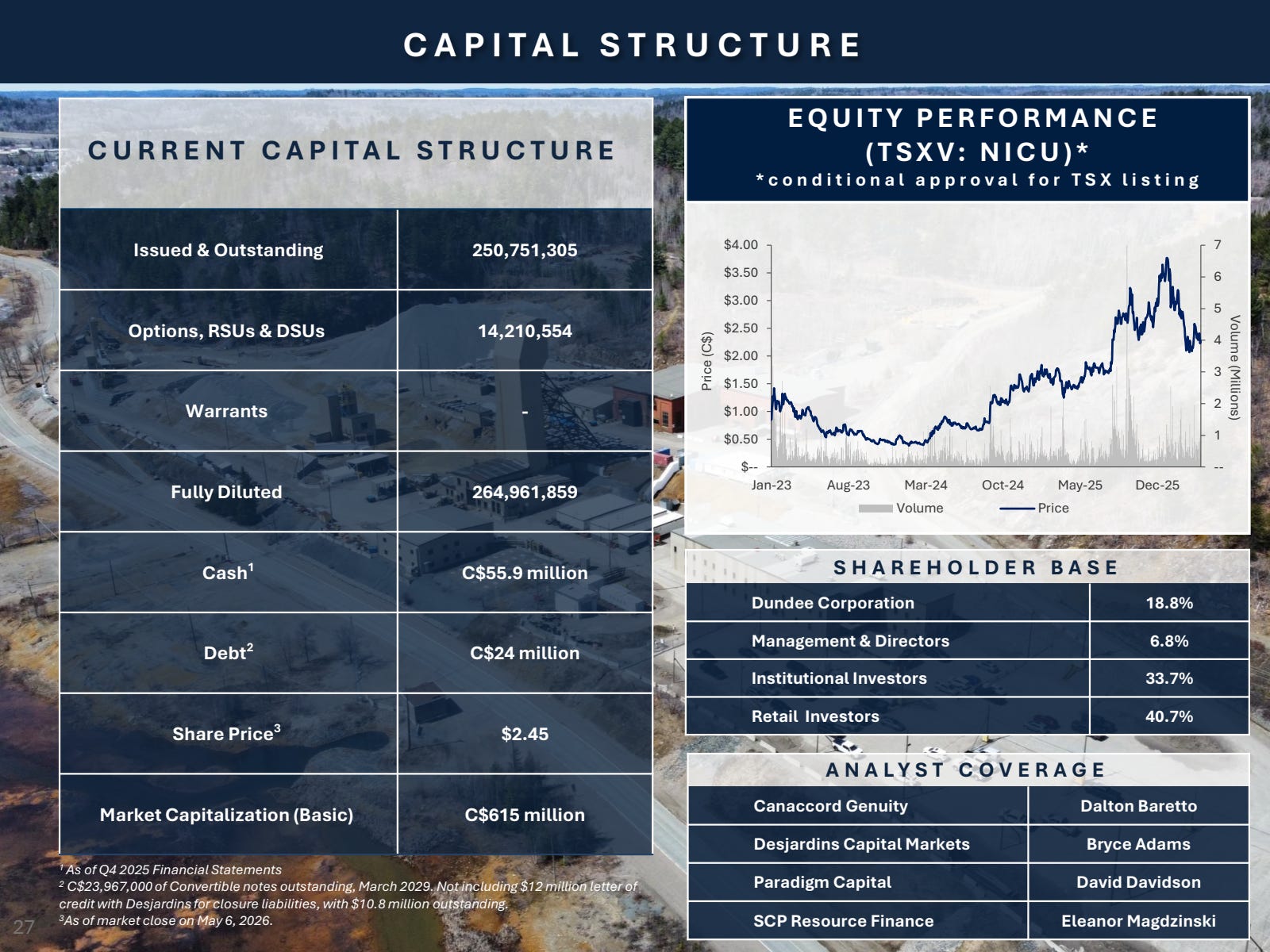
As of March 31, 2026, Magna held C$35.8 million in cash and cash equivalents and had working capital of C$53.7 million, against C$24 million in convertible notes maturing March 2029. As of the June 2026 corporate presentation, Magna had approximately 250.8 million basic shares outstanding and 264,961,859 shares on a fully diluted basis, with no listed warrants remaining in the capital structure. The debentures bear 10% interest and mature in March 2029, with no scheduled amortization; the company can force conversion into equity after the two‑year anniversary if the share price trades above 150% of the C$2.00 conversion price for a sustained period. which means the balance sheet presents no near-term financing pressure. This is not accidental — it is the architecture of a company that intends to fund development from operations rather than from equity markets.
A CEO Who Takes Dilution Personally
Jason Jessup co-founded Magna in 2016 and has been CEO since May 2021. He and the broader management and director group own 6.8% of the company. His stated plan, repeated across investor forums: MCW cash flow funds Levack, Levack and MCW fund Crean Hill, all three fund Shakespeare. At the 2025 Rule Symposium, Jessup was explicit: Magna sells ore directly to Vale's and Glencore's underutilised mills "no milling required" which eliminates the single largest capital expenditure in conventional mine development. The September 2024 KGHM acquisition was structured to fit this model exactly: four permitted, past-producing mines, zero mill-build required, accessible via infrastructure that already exists. This is the FNX playbook. Jessup ran it before. He is running it again.
The External Mill Advantage
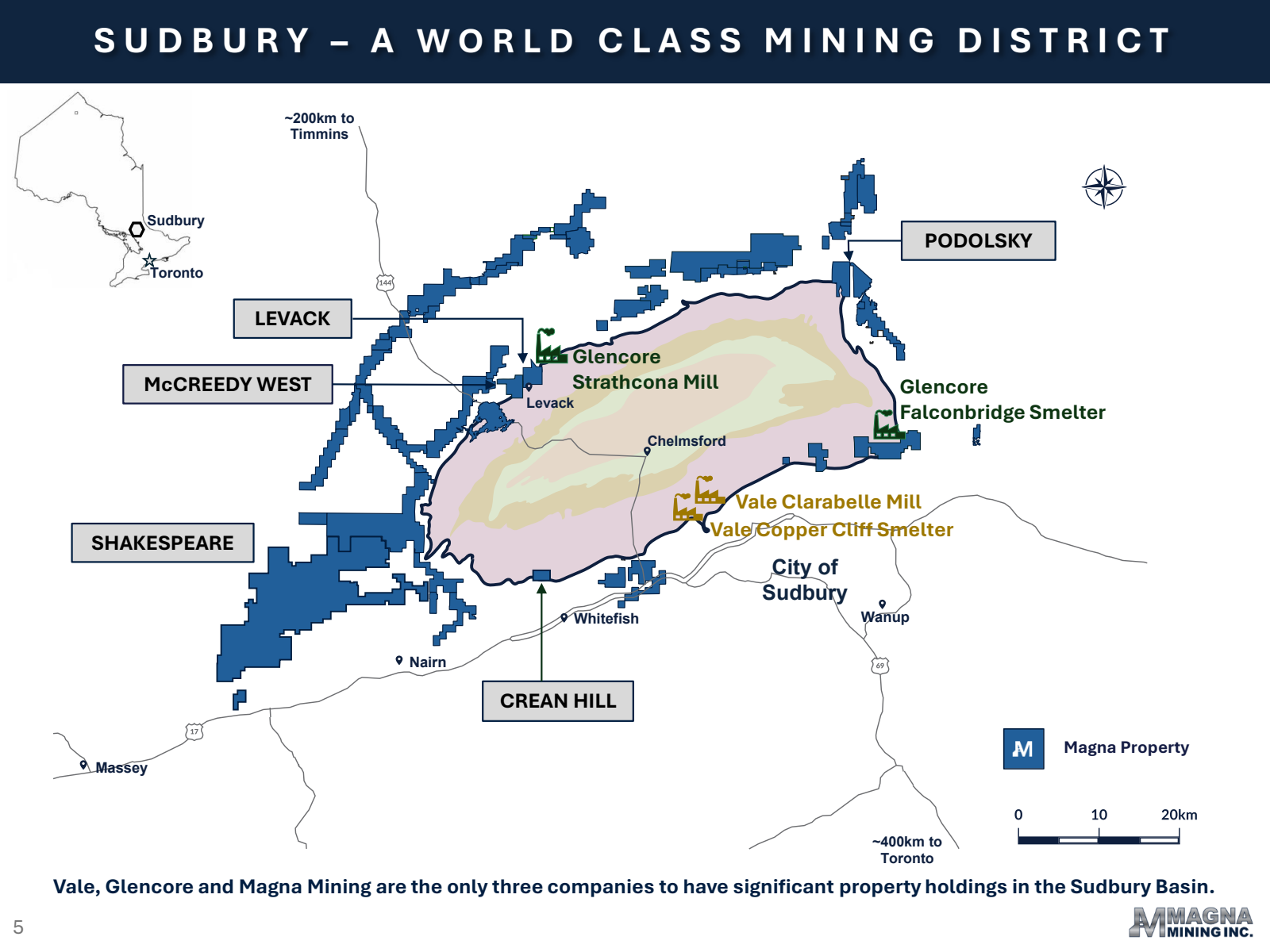
The reason Magna’s capital efficiency is structurally different from almost any comparable junior miner is the processing infrastructure that surrounds it. Sudbury hosts two large-scale processing facilities (Vale’s Clarabelle Mill and Glencore’s Strathcona Mill) as well as two smelters. Magna has confirmed processing relationships with both mills.
Vale’s Clarabelle Mill is the largest concentrating facility in the Sudbury Basin, with a nameplate capacity of approximately 40,000 short tonnes per day following a rationalisation expansion that consolidated three previously separate concentrators into one plant. At 40,000 t/day, the mill can process up to approximately 14.6 million tonnes of ore per year at full theoretical throughput. In practice it operates at utilisation rates well below nameplate. Ore from McCreedy West is shipped to Clarabelle as a primary customer; the mine’s ore is classified as footwall copper type, which is well-suited to Clarabelle’s flotation circuit, producing a copper concentrate and a separate nickel-copper bulk concentrate.
Glencore’s Strathcona Mill is located approximately 55 kilometres northwest of Sudbury, near the Levack townsite making it the physically closest major mill to both Levack and McCreedy West. Its maximum capacity is approximately 2.75 million tonnes of ore per year (approximately 7,500 tonnes per day), and in 2024 it processed 1,025,997 tonnes, roughly 37% of nameplate. Magna used Strathcona as recently as 2024 for a 20,000-tonne bulk sample from Crean Hill, signing a toll milling agreement with Glencore that confirmed the relationship. Strathcona produces two concentrate streams: a nickel concentrate trucked as slurry to the Falconbridge Smelter, and a copper concentrate trucked to external smelting.
The downstream infrastructure is similarly established. Vale’s Copper Cliff Smelter and Glencore’s Falconbridge Smelter both operate in the Sudbury Basin, receiving concentrate from their respective mill operations. The full processing chain (from run-of-mine ore at the portal to refined metal) exists and operates at scale.
What Zero Mill Capex Actually Means
The standard industry benchmark for building a new concentrating mill of meaningful scale in Canada runs to C$400–800 million or more, plus 3–5 years of permitting and construction. The Crean Hill 2024 PEA (a mine designed to produce 2,200 tonnes per day) showed net pre-production capital costs of just C$27,7M, net of pre-production revenues. The entire reason those numbers are possible is that processing infrastructure is outsourced to mills that already exist and actively want additional feed.
Mills are capital‑intensive assets with high fixed costs; higher throughput improves their returns on invested capital. Magna’s ore is additive feed for Clarabelle and Strathcona, which both have spare capacity, rather than displacing existing internal ore. The negotiating dynamic runs in Magna’s favour, not against it.