

Yesterday, Mako Mining signed a non-binding letter of intent with Sailfish Royalty to sell a twenty-year, corporate-level gold stream. The two companies share a controlling shareholder, so this is a related party transaction, and it is a complicated one. This piece works through what has actually been proposed, what it costs and returns in practice, and the questions that remain open ahead of the definitive agreement.
If you are new to the company, we already have a report out on Mako that could be read to get a better picture of the company first:

Part 1: The transaction
Mako proposes to sell Sailfish a stream on refined gold running 240 months, roughly twenty years. The delivery schedule steps up four times over the term:
650 oz a month until 1 August 2028
750 oz a month until 1 February 2031
900 oz a month until 1 February 2037
1,000 oz a month for the remainder of the term
Deliveries under the stream are due to begin on the first day of the month following closing, not from the date the LOI was signed.
Add it up and the total obligation runs to somewhere in the region of 219,000 oz over the life of the agreement. Sailfish pays 25% of the LBMA PM Fix for each ounce delivered.
The stream is unusual in that it is not tied to a specific mine. Mako can satisfy delivery from any source, including gold bought on the open market, with one explicit exception: the Mt. Hamilton project cannot be used to deliver against the stream, and it is also excluded from the security package entirely. That carve-out is specific enough to be worth its own discussion, which follows later in this series.
As consideration, Sailfish proposes to issue 70 million of its own shares to Mako at C$5.76 each, a price set by the five day volume weighted average price ending the trading day before the LOI was signed. On completion, Mako would hold approximately 49% of Sailfish, though Sailfish’s own release puts the figure at 48.54%, a discrepancy worth flagging given the two companies otherwise describe the deal in near identical terms.
The shares are not immediately tradeable. They carry a statutory hold of four months and a day, then a further contractual lock-up of twelve months, released in two equal tranches at six month intervals. Mako also agrees to placement rights (Sailfish’s right to arrange buyers if Mako looks to sell more than 500,000 shares at once, and a similar right on a change of control of Mako), a standstill and voting support obligations while it holds the stake, which in practice makes it a passive, locked-in holder rather than a free agent with a large equity position.
Because Wexford Capital controls both companies, this is a related party transaction. Mako’s side requires an independent formal valuation, being prepared by Evans & Evans, and a fairness opinion from Stifel. Both companies need approval from a majority of their disinterested shareholders before the deal can close.
Part 2: The net economics, in ounces
The headline numbers, 219,000 oz sold, a stream running to roughly 2047, make the transaction look larger than its actual annual burden once the other pieces are put back in. Two things claw back most of what Mako pays out.
First, the 25% cash payment on every ounce delivered. Second, once the shares are issued, Mako is entitled to its share of whatever dividend Sailfish pays on them, and Sailfish has said it intends to pay the cash equivalent of one ounce of gold a year for every 18,000 shares held. On 70 million shares, that works out to roughly 3,889 oz a year.
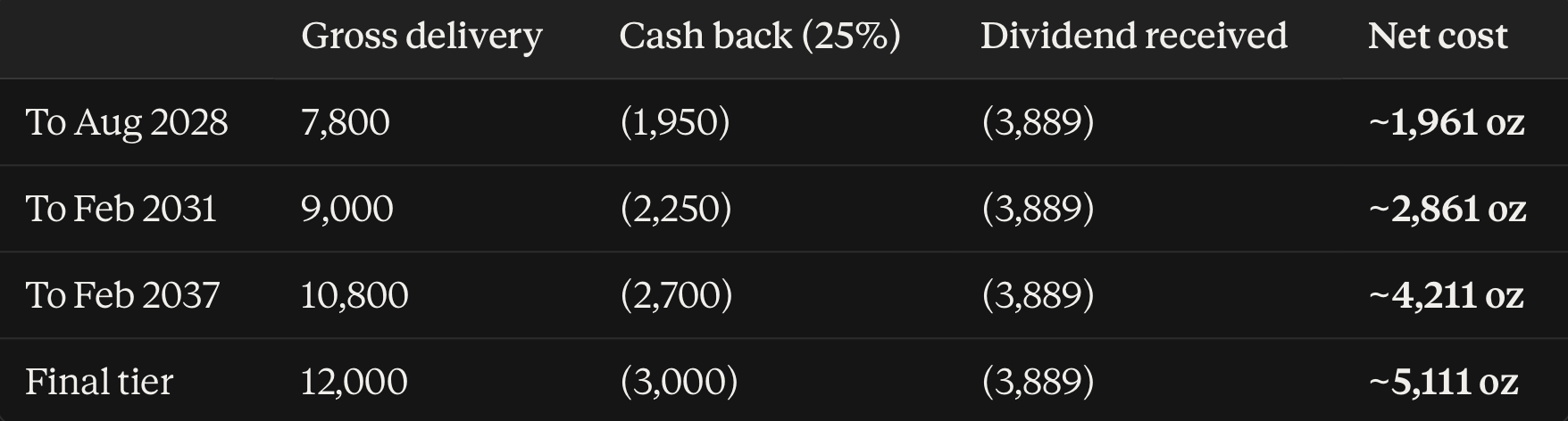
Put the three pieces together across the delivery schedule, holding the dividend offset at 3,889 oz a year throughout (more on why that assumption matters below):
Net cost in ounces:
Net cost in dollars, at $4,300 gold
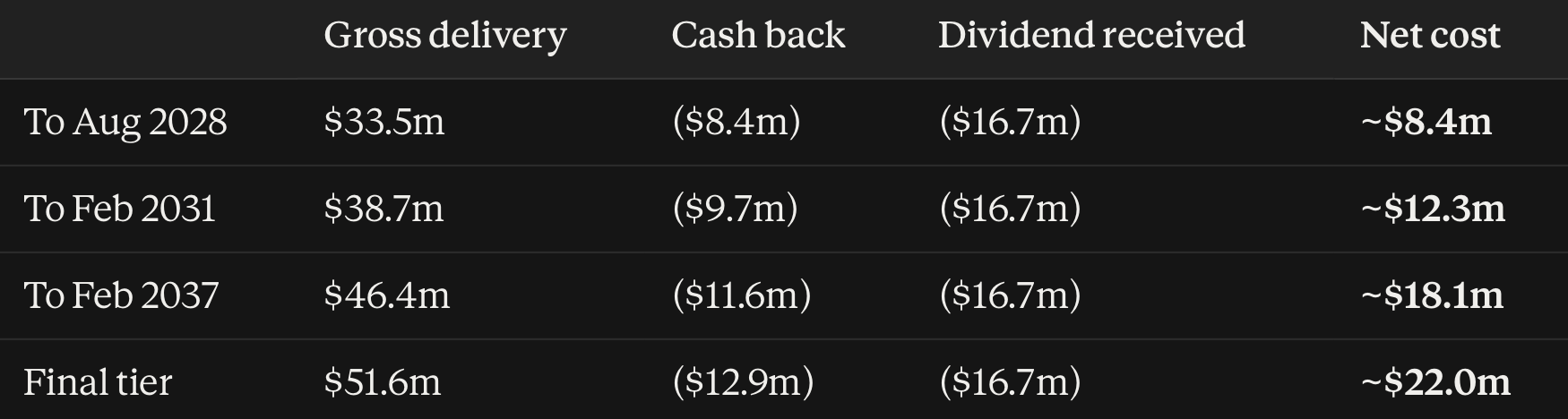
The net cost in ounces climbs 2.6 times over the life of the agreement, from around 1,961 oz to 5,111 oz. But measured against Mako’s own production, which our estimates have growing from roughly 60,000 oz this year towards over 150,000 oz by the end of the decade, the burden stays broadly flat at around 2 to 3% of output throughout. The schedule looks designed to track the company’s growth rather than to compound against it.
The obligation is fixed in ounces, so gold price moves change what it costs in dollars without changing what it costs in gold. At $4,300 the final tier runs to around $22m a year; at $5,000 the same 5,111 oz would cost over $25m.
None of this holds automatically, though. It depends on the dividend offset staying at 3,889 oz a year for the full twenty years, which in turn depends on Mako holding on to all 70 million Sailfish shares. That assumption is worth examining on its own terms, which is where the next part picks up.
Part 3: What to watch
The offset that makes the net cost look manageable rests on one condition: Mako keeps the shares. Management has been explicit that the Sailfish stake is not meant to sit untouched. Akiba has described it as a form of strategic financing currency, useful either as collateral or as consideration in future acquisitions, and Mako’s own release frames the shares as a route to lower cost financing rather than a passive holding to be kept indefinitely.
If half the position is sold or pledged away, the dividend received falls by half while the delivery obligation continues unchanged. Using the first tier as an example, the net cost would move from roughly 1,961 oz to roughly 3,906 oz a year, doubling the effective burden without any change to the terms of the stream itself. The offset is disposable. The obligation is not.
There is a case for reading this the other way. Leisman has suggested the Sailfish shares, once revalued under the new dividend policy, could be worth somewhere between $440m and $580m, based on the stake trading at a 3 to 4% gold linked yield. If that range holds, it implies Mako is sitting on a security worth considerably more than what it gave up, and one that could be pledged for financing at a cost well below what a conventional royalty or stream would charge, in the region of 7%. Whether that valuation is realistic is the open question, and even a meaningfully lower figure still leaves Mako with a genuinely useful asset. The more interesting question is what it gets used for. A well judged, accretive acquisition funded this way would justify the structure. A one off dividend funded by selling down the position would not, since it converts a twenty year obligation into a short term payout.
The second point concerns duration. The stream runs to roughly 2047. Moss, on its current reserve, has a mine life of around 15 years. San Albino carries no reserves at all, only resources that have historically been extended through further drilling. On the current asset base, the final several years of the stream have no obvious source of delivery gold. They would need to be covered either by acquisitions Mako has not yet made, or by buying gold on the open market and receiving only 25% of spot back, which is a materially worse proposition than delivering mined ounces.
These points do not make the transaction unattractive on their own. They set the conditions under which it becomes one thing or the other, and those conditions are largely in management’s hands rather than fixed by the terms of the deal.
Part 4: The Mt. Hamilton carve-out
One detail in the LOI invites a reading it does not support. Mt. Hamilton is excluded twice over: it cannot be used as a source of delivery gold, and it sits outside the new security package, while every other material asset in the Mako group is pledged, including the shares of Goldsource Mines, Eagle Mountain Gold Corp, EG Acquisition and Golden Vertex, along with a security interest in the Moss Mine and a pledge of the new Sailfish shares.
The obvious inference is that Mako is deliberately preserving one unencumbered asset. That inference does not hold. Mt. Hamilton is already pledged to Sailfish under the earlier agreement. Mako’s own filing on the February 2026 restructuring states that its obligations under the amended gold purchase agreement are “secured in favour of Sailfish by first-ranking security interests over all current and future assets of Mako and certain of its subsidiaries that hold a direct or indirect interest in the Mt. Hamilton Project”. Sailfish’s release describing the same agreement refers to “specific guarantees and pledges relating to an encumbrance by Sailfish over the Property”, with the Property defined as the Mt. Hamilton project itself.
The carve-out in the new LOI therefore looks less like protection and more like an artefact of the existing arrangement. Sailfish already holds first-ranking security over the project, which is consistent with the new stream being described as ranking behind the February 2026 agreement. There was no clean asset left to exclude.
Leisman’s own comments point to why. In a podcast interview from early September, he said the Moss reserve declaration was undertaken partly for disclosure reasons and partly for tactical ones, specifically to widen the type of capital the company could access. He then said Mako intends to go through a very similar exercise at Mt. Hamilton, and that doing so would expand its financing options further. Separately, discussing the tungsten skarn that sits beneath the gold and silver mineralisation at the same project, he said he does not want critical metals and precious metals financed inside the same corporate structure, on the view that mixing the two costs the company support from both sets of investors(Cerrado Gold is a good example of this). He described wanting a separate structure capable of raising capital against the tungsten on its own.
The reserve intention still stands on its own, independent of who holds security today. Existing pledges can be released, refinanced or ranked around, and a bookable reserve widens the range of lenders willing to have that conversation in the first place. At roughly 60,000 oz a year and an AISC near $1,600, Mt. Hamilton should generate gross margin in the region of $160m annually at $4,300 gold, which on a conservative bank price deck would support a facility comfortably above the project’s roughly $94m build cost. What the existing encumbrance changes is not whether such a facility is possible but what would have to be negotiated with Sailfish first.
It is worth noting that Mako has already shown it cares about this. The February 2026 restructuring scrapped a proposed 2% NSR on Mt. Hamilton, and Mako described the amendments as made “in order to preserve maximum flexibility for Mako to develop the Mt. Hamilton Project and derisk the impact of encumbrances over potential future development scenarios more broadly”. The concern about encumbering the project is documented. Resolving it is not.
This also resolves something that otherwise reads as inconsistent in the Sailfish release. Mako states that lower cost financing structures will let it return the majority of its $112m in cash, receivables and marketable securities (The gold linked securities) to shareholders, yet the Sailfish transaction itself delivers shares rather than cash, and those shares are locked up. Any facility that covers the construction spend does exactly that, by releasing cash otherwise earmarked for the build. Mt. Hamilton is the natural candidate given its scale, but the existing security in Sailfish’s favour means such a facility is not simply a matter of Mako pledging an unused asset.
Timing is the weaker link in this reading. Full-scale construction has slipped with the Forest Service amendment; Akiba’s recent comments point to first gold closer to Q3 2027 than to a November 2026 start. Capex is still described as an $85m roof plus $8–9m of pre-production mining, or about $94m in total, but a bookable reserve requires a full technical report, and Moss took roughly 16 months from acquisition to reserve declaration. Mt. Hamilton was acquired in March 2026. Management has said the historical resource model does not meet the standard required and has hired a senior geologist specifically to rebuild it. On that basis, a reserve looks more plausible in H2 2027, which would place it in the middle of construction rather than ahead of it.
The tungsten angle looks like a separate track rather than part of this plan. It is blocked behind the same Forest Service approval process that is currently holding up the main permit amendment, and management has been explicit that it wants it structured outside the gold company altogether. The logic is the same arbitrage underlying the Sailfish transaction itself: move an asset into whichever structure the market is willing to pay more for.
A second transaction with Sailfish is openly contemplated in its own release, with management pointing to a broader relationship with producing gold companies generally. Given that Sailfish already holds first-ranking security over Mt. Hamilton, a second transaction would more plausibly be built around a different asset, or around whatever Mako acquires next.
The risk is broader than a single asset. Once the new stream closes, Sailfish holds security across essentially the whole Mako group in two ranks: first under the February 2026 agreement, which covers Mt. Hamilton and the entities holding it, and second under the new stream, which covers everything else. Mako’s capacity to raise secured financing elsewhere depends on what Sailfish is willing to release or subordinate, and the two companies share a controlling shareholder. Mt. Hamilton still carries the execution risk it always did, with no construction decision taken, no reserve, no technical report of Mako’s own, and a permit caught in a Forest Service review that has already consumed its schedule buffer. The difference is that the project is not the unpledged fallback the new carve-out makes it appear to be.
Part 5: The currency question and the special dividend
Sailfish’s own release, published alongside Mako’s, adds two details that change the shape of what Mako is actually receiving.
The board has approved a special dividend of $1.00 per share, payable after the transaction closes but with the shareholder record date set before closing. That timing matters. Mako’s 70 million shares are not yet on the register when the record date falls, so they do not qualify.
The practical effect is that Mako is buying into Sailfish just after a large slice of its cash position has been earmarked to go out the door to shareholders who are not Mako.
On the question of which currency the $5.76 issue price is quoted in, Leisman has made the point that this is not the number to focus on. The precise denomination matters less than the resulting ownership stake, since Mako’s economic interest in Sailfish’s future cash flows and dividend is fixed at roughly 48.5% regardless of how the initial consideration is expressed. The more substantive question is whether $5.76 represents fair value for the stream in the first place, which is precisely what the valuation and fairness processes described below are meant to test.
That leads to the second asymmetry in the release. Mako must obtain a full independent formal valuation under MI 61-101, prepared by Evans & Evans, in addition to a fairness opinion from Stifel. Sailfish is relying on an exemption, on the grounds that its shares are not listed on a specified market, and will obtain only a fairness opinion, from INFOR Financial. Both companies need approval from a majority of disinterested shareholders, but only one side is required to produce an independent valuation of what is being exchanged.
Part 6: The collateral alternative
One structural question that comes up once the shares are actually in hand is what Mako does with them afterwards. Management has described the Sailfish stake as a form of strategic financing currency, which in the context of the release reads mainly as consideration Mako could use in a future acquisition or dispose of to raise cash. There is a third option worth setting out, which is that Mako pledges the shares as collateral rather than spending them, and keeps both the position and the dividend it pays.
The mechanics support this. Sailfish shares are listed and, once the amended dividend policy takes effect, income generating. Lending against a listed equity position at 35 to 40% of value is a standard structure. On 70 million shares, the USD value at the prevailing OTC price of about US$4.22 is roughly US$295m. A 35–40% advance against that is about US$100–120m, close to the roughly $94m Mt. Hamilton is expected to cost to build. Structured this way, the stake would fund construction without Mako giving up either the shares or the dividend income attached to them, leaving both available for whatever comes next, whether that is an acquisition or a return of capital to shareholders.
The lock-up complicates this in practice rather than ruling it out. The shares carry a 12 month contractual lock-up, released in two tranches at six month intervals, plus placement rights that limit how Mako can dispose of a large block if it ever needed to. A lender would likely either wait for some of that lock-up to run off or apply a lower advance rate to compensate for the restricted liquidity in the meantime, which pushes the realistic financing available down from the headline figure and means any such facility would take longer to put in place than the numbers alone suggest.
There is also a case that the facility is not strictly necessary. Pre-production costs at Mt. Hamilton, including a working capital reserve, are expected to run to $90m to $100m, and against a current cash position above $100m plus free cash flow from two producing mines, Mako does not have a funding gap for that project on its own. What a collateral facility would add is optionality rather than a missing piece. It would let the company fund Mt. Hamilton, pursue acquisitions and/or return capital to shareholders more or less simultaneously, rather than choosing between them, by using the Sailfish position to unlock financing instead of running down the balance sheet or the position itself to do the same thing.
Nothing in the terms released so far indicates this is the plan. It is set out here as a route the Sailfish shares open up once received, not as a signal of what management intends to do with them.