1. Summary
Part 1 ended on a market in which utilities have contracted less than they burn, supply has been slow to answer and the long-term price sets the direction. Since then that price has moved again. Cameco’s month-end series put it at $98.00/lb at the end of October, a new high, with spot at $91.55. The shares and the trusts have not followed. The question for this part is a practical one: if the reading in Part 1 is right, what should an investor own, and what does each choice cost if it is wrong?
There are three ways in, and each pays out on a different clock.
The physical trusts pay on today’s price, bought at a discount. On 4 November units of the Sprott Physical Uranium Trust traded 13.4% below NAV. A buyer was therefore paying about $79.50 for a pound of uranium that the trust marks at about $92 and that utilities contract at $98 for future delivery. The discount is both the opportunity and the hazard: it can widen as easily as it closes, and the trust adds nothing to spot demand until it trades at a premium again.
The producers pay on a lagged clock. Contracts signed years ago set what they receive, so their earnings follow spot slowly. Cameco’s own sensitivity table shows a realised price in 2027 of $68 to $74/lb whether spot sits at $80 or at $120. In return the shares carry operating leverage that no trust can offer. Cameco also holds 49% of Westinghouse, which has filed confidentially for a US listing; on the valuation reported in September, that stake alone would be worth most of Cameco’s market value. Kazatomprom passes more of the spot price through than Cameco does. Paladin and NexGen are priced mostly on mines that have yet to be built.
The ETFs sit between the two. They hold the miners and, in URNM’s case, a sizeable slice of the Sprott trust, so a buyer gets a blend of both clocks and pays a fee for the mix.
Our method is the one we used for coal. Chapter 4 values Cameco, Kazatomprom, Paladin and NexGen at $80, $100 and $120/lb. Every figure is our estimate, built on company guidance and filings, and each price is a reference point rather than a target. Chapter 5 shows what the discounts say about sentiment and tests whether December tax-loss selling offers a better entry. Chapter 6 sets out the risks that sit with each vehicle rather than with the market.
We do not argue that one route beats the others. We show what each one pays for, so that readers can set our assumptions against their own.
2. SPUT and Yellow Cake
Owning uranium through a trust means owning two numbers at once: the price of the metal and the discount at which the vehicle trades to it. The Sprott Physical Uranium Trust holds one pound for every 4.2 units. On 4 November a unit cost $19.11 against a net asset value of $22.07, a discount of 13.4%. The trust marks its pounds at $91.96. Strip out the $0.24 per unit it holds in cash, and the market price pays $79.51/lb for uranium that utilities were contracting at $98.00 at the end of October. The gap to that long-term price is $18.49/lb.
How the trust behaves
SPUT issues units only at or above net asset value, and the proceeds go into uranium. That built the largest financial holding of uranium: units worth $1.78bn were sold between the start of 2024 and June 2026. The tap has been shut since 22 June. Units traded at a premium on 12 of 251 days in 2025, 16 of 62 in the first quarter of 2026, 6 of 63 in the second and none in the third. Nothing in the structure forces the gap shut. The units are not redeemable, and the board looked at adding a redemption feature in December 2023 and decided against it, so only new buyers can close the discount.
A discount is also the trust’s normal state. In 2025, a year when spot rose, units still traded below NAV on 239 of 251 days. Since inception to 30 September the trust’s NAV has compounded at 19.83% a year and its units at 17.43%, so the discount has cost a holder 2.4 points a year. This year the damage came faster: to the end of September the NAV was up 8.69% while the units were down 4.10%, a shortfall of 12.8 points in nine months.
Costs come on top. The management expense ratio of 0.71% is about $54m a year on today’s NAV, against $81m of cash. With the discount unchanged, spot has to reach about $92.60/lb for a unit to cover one year of those costs, less than 1% above the trust’s own mark.
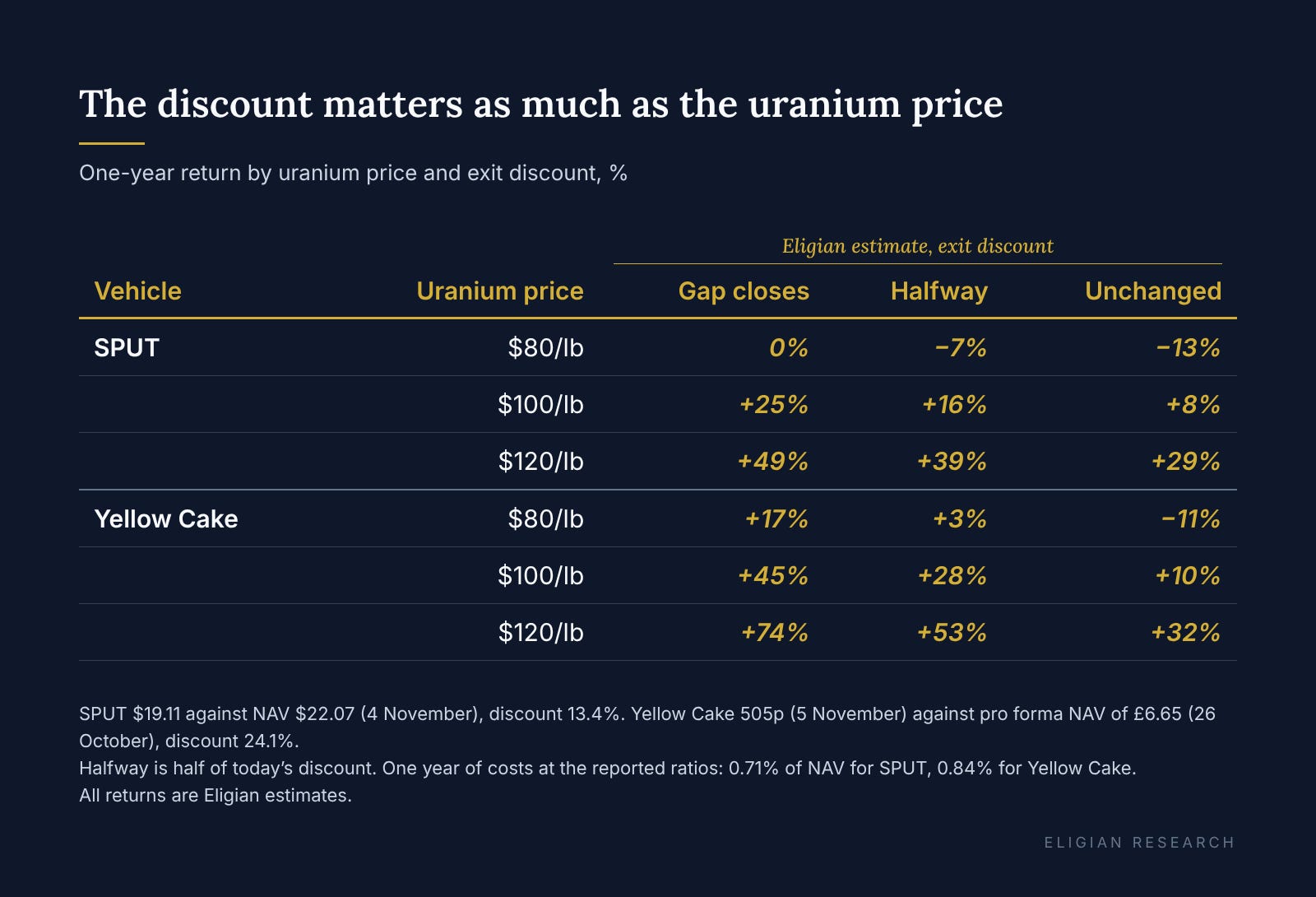
The table shows why the discount matters as much as the metal. At $80/lb the trust’s NAV equals today’s market price, so a holder is flat if the gap closes and down 13% if it does not. At $100/lb a closing gap returns 25%, of which 17 points come from the gap and the rest from uranium. If the discount stays, the same $100 uranium returns 8%. A holder who is right on direction earns the metal’s move less costs, and nothing for the discount.
How each has grown
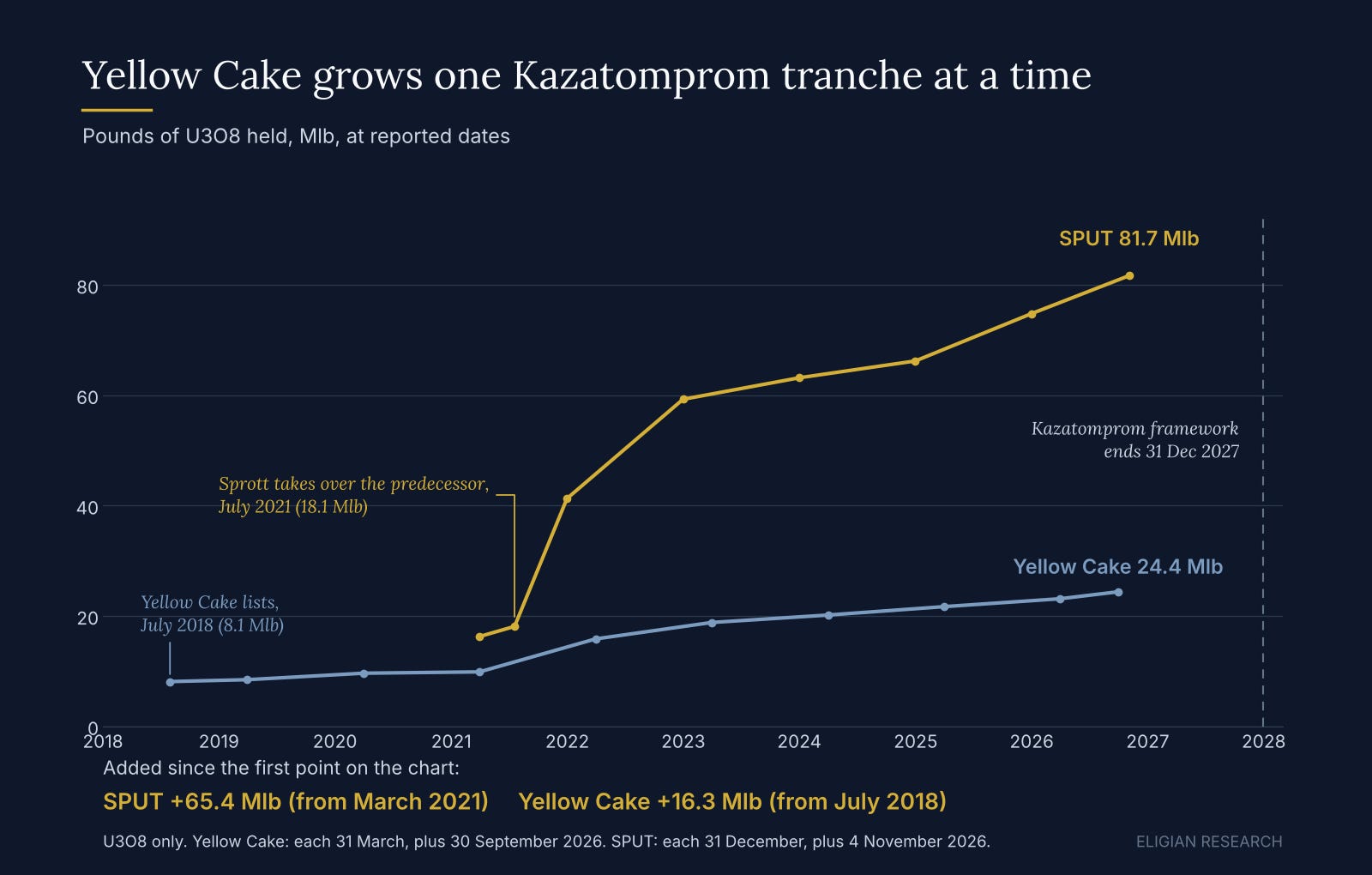
The trust took over 18.1 Mlb from its predecessor in July 2021, ended that year at 41.3 Mlb, and added 18.0 Mlb in 2022, 3.9 in 2023, 3.1 in 2024 and 8.6 in 2025. Yellow Cake bought 8.1 Mlb at its listing in July 2018 and held 15.8 Mlb by March 2022. In each of the last three financial years its holdings rose by one Kazatomprom tranche, give or take 0.1 Mlb: tranches of 1.35, 1.53 and 1.33 Mlb against additions of 1.35, 1.52 and 1.43 Mlb. Since 22 June SPUT has stood still at 81.7 Mlb, and Yellow Cake’s pounds depend on one agreement that ends next year.